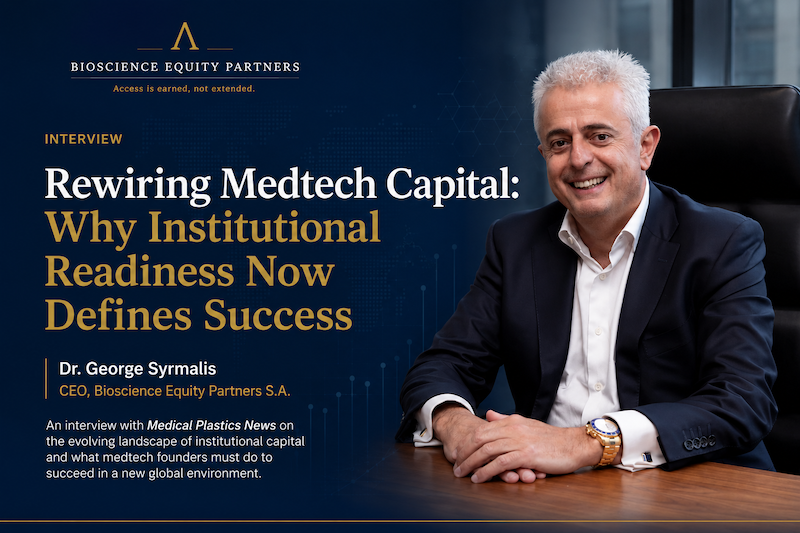
Rewiring Medtech Capital: Dr. George Syrmalis on Why Institutional Readiness Now Defines Success

Dr. George Syrmalis, CEO of Bioscience Equity Partners S.A., speaks with Medical Plastics News on how early-stage medical device companies must evolve beyond scientific strength and become institutionally ready for cross-border and sovereign capital.
Bioscience Equity Partners S.A. is pleased to highlight a recent interview with Dr. George Syrmalis, CEO of BEP, featured in Medical Plastics News, where he discusses the changing capital landscape for early-stage medical device companies across Europe and North America.
The interview, titled “Rewiring medtech capital: Why institutional readiness now defines success,” explores why scientific excellence alone is no longer sufficient for medtech companies seeking serious institutional investment.
Dr. Syrmalis explains that many early-stage medical device companies are highly capable from a scientific, clinical, and regulatory perspective, yet remain underprepared for the realities of institutional capital. The gap, he notes, is not usually in the technology itself, but in the company’s ability to present a mature, investable, and strategically structured proposition to sophisticated investors.
A central theme of the discussion is the growing role of sovereign and international capital, particularly from the Gulf, in filling the funding gap left by increasingly selective traditional venture capital. Unlike conventional venture investors, sovereign institutions often assess opportunities through a broader strategic lens, considering factors such as national healthcare priorities, technology transfer, infrastructure development, market access, and long-term economic transformation.
As Dr. Syrmalis highlights, this requires medtech companies to approach capital raising with a level of preparation closer to pre-IPO institutional readiness, rather than simply preparing for a conventional venture round.
The interview also examines the challenges of cross-border funding, including valuation differences, governance expectations, board composition, decision-making rights, and the need for simpler, more transparent equity structures. These factors are increasingly important when engaging with investors operating across different regulatory, financial, and cultural frameworks.
Another key point raised is the importance of defining a company’s long-term capital trajectory. Rather than moving reactively from round to round, successful medtech companies must begin with a clear end-state, whether that is a public listing, trade sale, licensing model, or strategic partnership, and work backward to build a connected funding pathway.
Dr. Syrmalis also points to a wider shift in global medtech capital, with institutional investors from the Gulf and Asia becoming more influential in the sector. These investors are not only seeking financial returns, but also access to healthcare innovation, manufacturing capability, regulatory insight, and technologies aligned with long-term national priorities.
The discussion reinforces BEP’s view that the future of successful medtech financing will depend not only on strong science, but also on institutional maturity, governance discipline, strategic alignment, and capital structures built for longer development timelines.
In particular, the interview identifies several areas attracting international capital, including cardiovascular devices, surgical robotics, advanced diagnostics, and point-of-care diagnostics for emerging markets, where unmet clinical need and strategic relevance remain significant.
Ultimately, the interview underlines a core principle of BEP’s investment philosophy: the companies best positioned for success will be those that combine scientific rigor with institutional-grade preparation, strategic capital planning, and the ability to engage global investors as long-term partners.